Car vs Bus for Group Travel in Pakistan: Why One Coaster Beats Seven Cars
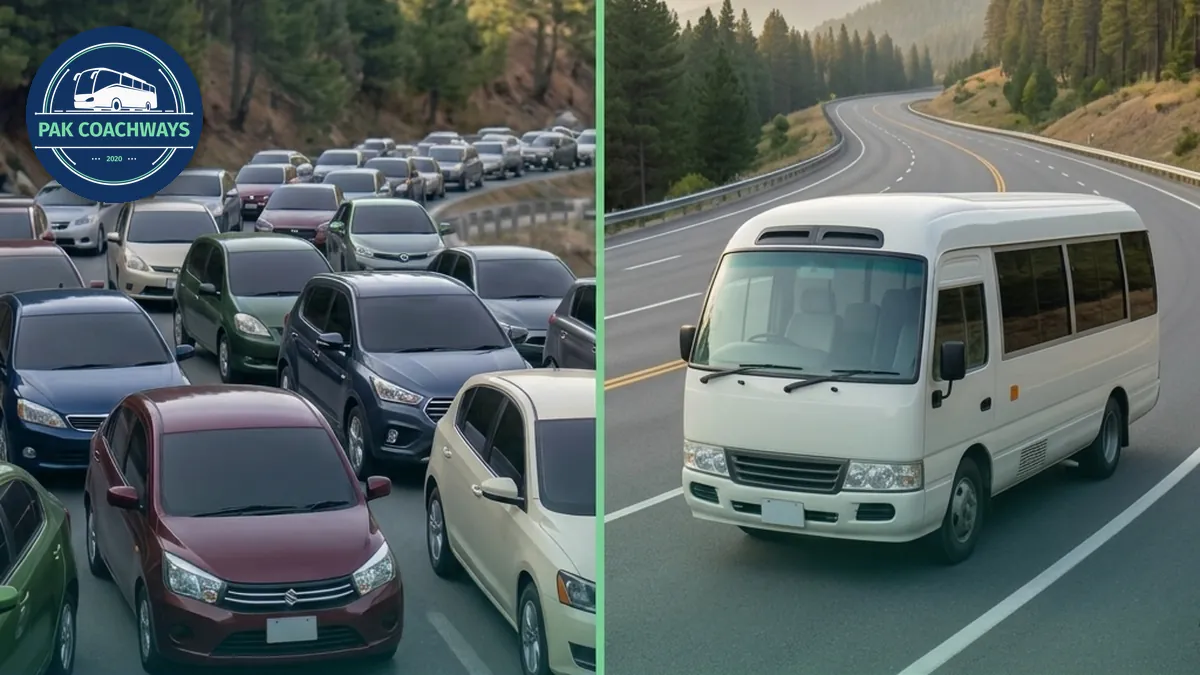
Planning a trip with family, friends or colleagues? The first question is usually "kitni gaariyan chahiye?", meaning how many cars will we need. For a group of 28, the answer is seven cars, seven drivers, seven fuel stops and seven parking spots. Or one coaster.
This guide compares car vs bus travel for groups in Pakistan on the things that matter: traffic, air pollution, CO2, real cost, comfort, and the fun of travelling together.
Quick answer
For groups of about 8 people or more, a bus or coaster is usually the better choice than several cars. It puts one vehicle on the road instead of five to seven, uses three to five times less fuel, produces roughly 60–80% less CO2 on a typical hill trip, needs one parking spot and keeps the whole group together. A car still makes sense for 1 to 4 people, or for short trips with many separate stops.
Car vs bus: side-by-side comparison
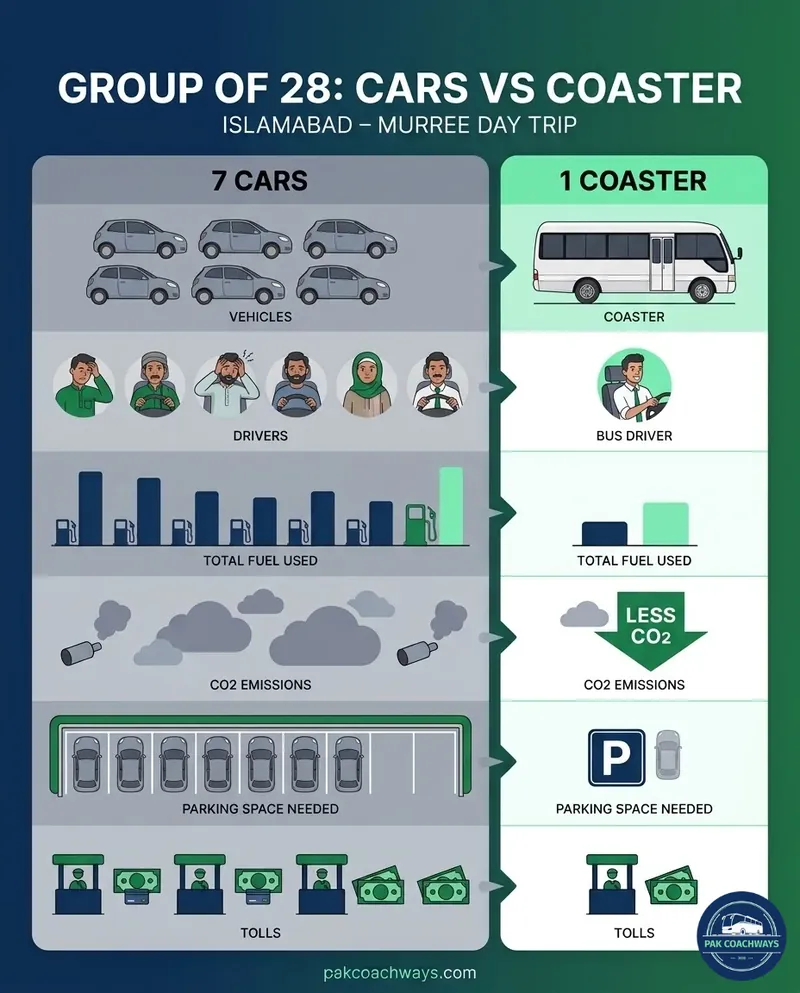
For a group of 28 people on a day trip:
| Factor | 7 cars | 1 coaster |
|---|---|---|
| Vehicles on the road | 7 | 1 |
| Drivers needed | 7 (people from your group, no rest) | 1 (professional driver) |
| Fuel for Islamabad–Murree return* | about 70 litres of petrol | about 17 litres of diesel |
| CO2 for the same trip* | about 162 kg | about 46 kg |
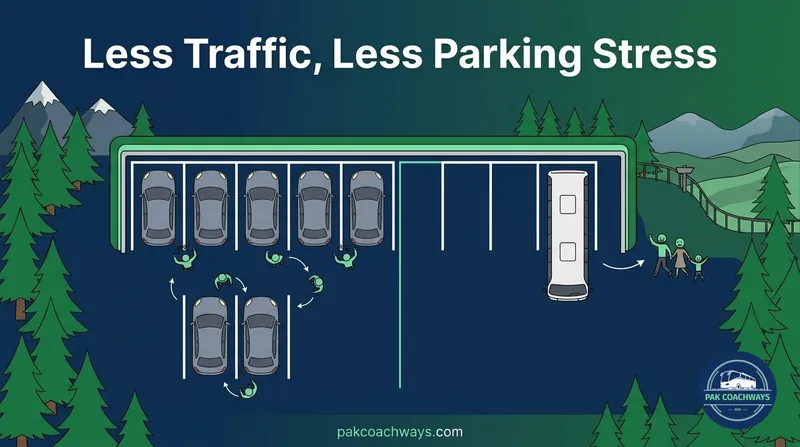
| Parking spots needed | 7 | 1 |
| Toll payments | 7 | 1 |
| Group together on the road | No, split across 7 cars | Yes, everyone in one place |
| Arrive at the same time | Rarely | Always |
*Worked example explained in the CO2 section below. Real figures depend on the vehicle, load and road.
1. Traffic: fewer vehicles, fewer jams
Pakistan's roads are filling up fast. A PIDE study found registered vehicles grew from about 4.47 million in 1990 to over 39 million in 2025, an increase of more than 770%. Every extra car on a narrow hill road or a busy city street adds to the jam.
A group that travels in one coaster takes up the road space of roughly two cars instead of seven. That matters most where traffic is worst:
- Murree and Nathia Gali on weekends, when the Expressway and Mall Road back up for hours
- Wedding venues and marquees, where seven cars arriving at once block the entrance
- School gates and office parks, where one pickup point beats seven
There's also convoy stress. With several cars, someone always misses an exit, stops for fuel at the wrong time or gets stuck behind a truck. A single vehicle means one route, one plan and no "aap log kahan ho?" phone calls.
2. Air pollution: part of the smog solution
Every winter, smog covers Lahore and much of Punjab. Transport is one of the biggest causes. Punjab's Urban Unit emissions inventory, cited by PIDE, attributes about 83% of Lahore's emissions to the transport sector. Other studies give lower shares, but they all put vehicles near the top.
One coaster carrying 28 people burns far less fuel than seven cars carrying the same group. That means less exhaust, less soot and fewer engines idling at every signal. It won't fix the smog on its own, but it's one practical choice every group can make.
3. CO2 emissions: a real worked example
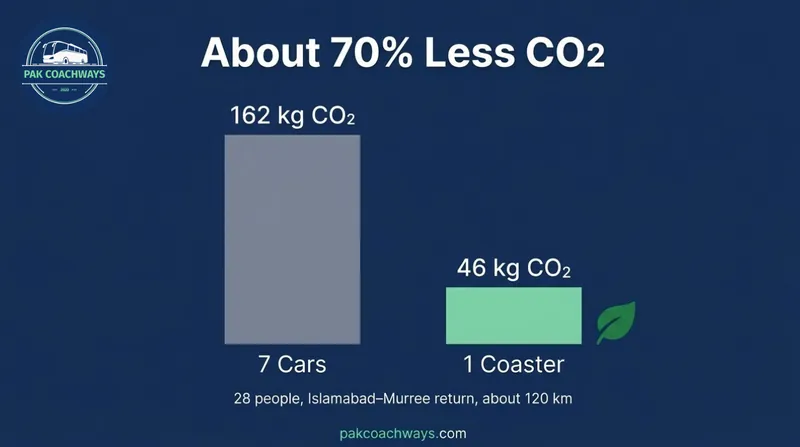
Let's compare a group of 28 people going from Islamabad to Murree and back, about 120 km in total:
- 7 petrol cars at about 12 km per litre on hill roads use around 70 litres of petrol. At 2.31 kg of CO2 per litre, that's about 162 kg of CO2.
- 1 diesel coaster at about 7 km per litre uses around 17 litres of diesel. At 2.68 kg of CO2 per litre, that's about 46 kg of CO2.
That's roughly 72% less CO2, or about 1.6 kg per person instead of 5.8 kg.
Fuel averages vary with the vehicle, the load and the road, so we checked the range too. If the coaster does anywhere from 6 to 8 km per litre and the cars anywhere from 10 to 14, the coaster still produces between 60% and 80% less CO2 and uses three to five times less fuel. The exact numbers move; the answer doesn't. International figures point the same way: one UK coach operator's calculator puts a coach at about 34 g of CO2 per passenger-km, against about 206 g for a petrol car with one person in it.
4. Cost: what seven cars really cost
Splitting a bus fare often looks expensive until you add up everything seven cars cost:
- Fuel for seven engines, not one
- Seven toll payments on the motorway or Expressway
- Seven parking fees at the hill station, the venue or the picnic spot
- Wear on seven cars: tyres, brakes, oil, and the occasional breakdown in the hills
- Seven drivers who can't relax, plus the risk of driving tired on the way home
With a hired coaster you get one written quote for the vehicle and driver, with tolls and parking for one vehicle, split across everyone. For most groups of 15 or more, the cost per person comes out lower. Get a quote and compare it with your own car costs before you decide.
5. Group fun: more than 4 seats
A car fits four or five people. A trip is about the whole group.
- Everyone travels together. Elders, kids, cousins, colleagues: nobody is left in "the other car".
- The journey becomes part of the trip: antakshari, jokes, snacks passed down the aisle, group photos at the viewpoint.
- Nobody has to drive. The person who usually drives gets to enjoy the trip too.
- One rest stop for everyone, so chai and namaz breaks happen together, not in seven different places.
- Planning is easier: one pickup plan, one departure time, one arrival.
- Family visiting from abroad? One coaster from the airport takes everyone home together, luggage included.
For weddings, school trips and office outings, travelling together is half the experience.
6. Comfort and safety
- A professional driver who drives these routes regularly, with driver details shared before the trip
- Rested passengers, because no family member drives for hours
- Space for luggage, prams or wheelchairs if you mention them when booking
- Better suited to hill roads: a coaster handles the roads to Murree, Naran or Swat well, with room for everyone
When a car is still the better choice
To be fair, a bus is not always the answer:
- 1 to 4 people: a car is simpler and cheaper.
- Short city trips with many different stops for different people.
- When people need to leave at different times, for example guests coming and going from a wedding.
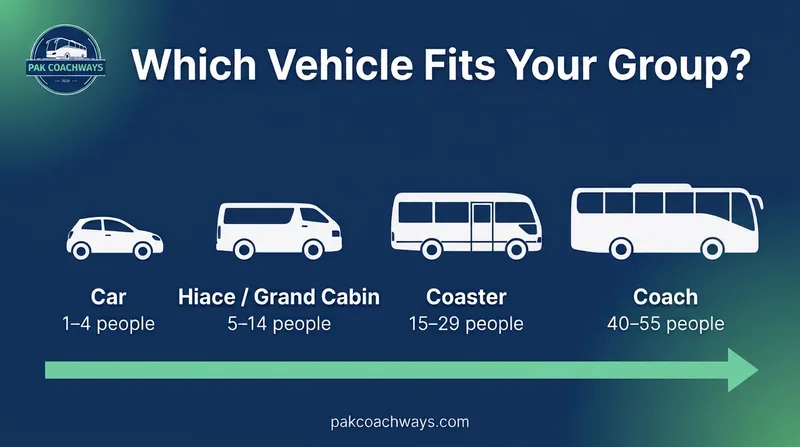
For 5 to 14 people, a Toyota Hiace or Grand Cabin is usually the sweet spot between a car and a coaster.
Which vehicle fits your group?
| Group size | Best choice |
|---|---|
| 1–4 | Car |
| 5–14 | Toyota Hiace or Grand Cabin (Grand Cabin seats 13–14) |
| 15–29 | Toyota Coaster (most seat 26–29; a Coaster 4C seats 25) |
| 30–39 | A coach, or two coasters for hill roads |
| 40–55 | Full-size coach (for example a 52-seater) |
Comparing a coaster with a bigger bus? See our guide to coaster vs mini bus vs coach.
Frequently asked questions
Is a bus cheaper than travelling by car for a group? For groups of about 15 or more, usually yes, once you count fuel, tolls, parking and wear for every car. For 1 to 4 people, a car is cheaper.
How much CO2 does a coaster save compared with cars? For 28 people on a 120 km Islamabad–Murree return trip, our estimate is about 46 kg for one coaster against about 162 kg for seven petrol cars. Across realistic fuel averages, that's a 60% to 80% cut.
How many cars does a coaster replace? A coaster with 26 to 29 seats replaces six to seven cars carrying four people each.
Can a coaster go to Murree, Naran or Swat? Yes. Coasters are the usual choice for hill routes, as they are compact enough for mountain roads while carrying the whole group.
How much does it cost to rent a bus for one day? The rate depends on the vehicle, the hours, the distance and the date. A coaster for a few hours in the city costs far less than a full day in the hills. Send your route and date, and we reply with a written per-day rate.
Plan your group trip

Need to rent a bus with driver for your group? Tell us your route, date and group size, and we'll suggest the right vehicle with a written quote within 2-4 hours. See coaster on rent, Hiace on rent, tours to the northern areas, office and corporate transport or bus rental in Islamabad, or request a free quote.
Sources: PIDE study on vehicle growth in Pakistan, 1990–2025; PIDE, Tackling Smog in Pakistan, citing the Punjab Urban Unit emissions inventory; National Express carbon calculator (coach vs car per passenger-km). Fuel use in the worked example is an estimate; real use depends on the vehicle, load and road.